
Buying or selling securities based on rumours about expected changes in tax rates or sectoral sops can backfire, advises Sarbajeet K Sen.

The US Trade Representative noted that India's average applied tariff rate stood at 17% per cent, the highest of any major world economy.
The life insurance industry does not have a good track record when it comes to passing on tax benefits to policyholders, points out Harsh Roongta.

Nirmala Sitharaman's messaging was clear when she presented a well-balanced Budget with an eye on state elections in nine states followed by a general election next year, observes Ramesh Menon.

Finance Minister Nirmala Sitharaman on Wednesday raised the personal income tax rebate limit, doled out sops on small savings and announced one of the biggest hikes in capital spending in the past decade as she did a tight rope walk in the Budget between staying fiscally prudent and meeting public expectations in the year before general elections.

'File all the supporting documents in response to the allegation since there is a possibility of the proceedings getting dropped at that stage if the reply is satisfactory.'

The pre-Budget proposals sent to the finance ministry aim to bring uniformity in tax treatment for investments in different financial sectors, mitigate hardship to retail taxpayers, and encourage participation in mutual funds.

The Budget proposals are expected to boost the fortunes of consumer goods and fast-moving consumer goods companies, which have been struggling with poor consumer demand for more than a year. The Budget announcements, such as the increase in standard deduction by Rs 25,000 for income-tax payers and slab revisions, will put more money in their hands, boosting consumer demand. Private consumption is also likely to benefit from a new scheme to offer internships to 10 million youths in the country's top 500 companies.
The government's capex spend is expected to rise and much of this is likely to be focussed on rural India, particularly for housing, roads and irrigation.
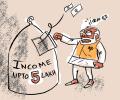
Policymakers are examining the possibility of increasing the tax-free slab to Rs 5 lakh in the two-year-old alternative personal income tax regime to make it attractive, a government official said. At present, taxpayers don't pay income tax if their taxable income is Rs 2.5 lakh and below. Increasing the threshold will reduce the tax outgo for assessees, thereby leaving more money with them to invest, the official said.

Ask rediffGURU and PF and MF expert Janak Patel your mutual fund and personal finance-related questions.

A taxpayer whose deductions and exemption claims are less than Rs 3.75 lakh annually would be advised to opt for the new income tax regime and pay less tax than they gave in the old regime, a senior finance ministry officer said on Wednesday. The Income Tax Department has arrived at the figure after making due calculations for ensuring a "hassle-free and less tax rate" filing regime for the assessees, he said. Union Finance Minister Nirmala Sitharaman, while presenting the Budget for 2023-24, said the government has made the new income tax regime more attractive for taxpayers bringing "substantial changes" in its structure for the benefit of the middle class.

Indian fintechs and associated entities are hoping that the Union Budget 2024 will provide a boost and empower firms to extend their reach beyond Tier-II regions, with an emphasis on supporting enterprises led by women. The fintech industry, which has witnessed regulatory reforms over the last year, expects the Budget, scheduled to be presented by Finance Minister Nirmala Sitharaman on February 1, will further encourage financial inclusion, empower micro-small-medium enterprises (MSMEs) with lending solutions, and push for upskilling initiatives for the country's young workforce.

India SME Forum, an organisation for small and medium businesses, has called for creating a dedicated fund of Rs 5000 crore for the export capacity development, promotion, and marketing of Micro, Small & Medium Enterprises (MSMEs) in its Budget recommendation. The forum for MSMEs with over 98,000 members said that to enhance India's global competitiveness and increase its market share in global exports, it was "crucial to increase the number of active exporters and enable at least 3-4 lakh first-time micro, small, and medium exporters while supporting them in promoting Indian products globally."

Fresh plans of privatisation or divestment in central public sector enterprises and public sector banks might take a back seat this financial year because these may require a large consensus among coalition partners.

Ask rediffGURU and PF expert Nitin Narkhede your mutual fund and personal finance-related questions.

The road ahead will require navigating complex financial challenges while fostering job creation and sustainable development in the region.

'India is showing a reasonable amount of resilience, but we are still living in a world that is quite fragile.' 'That's why we hope that the government will continue to invest significantly in public capex so that we are able to ride through this cycle till the private sector is able to play its part in investing and adding to the capex cycle.'

Your financial goals are of utmost importance and the tax saving is an added incentive, advises Dwaipayan Bose.

'By investing in a basket of funds, FoFs can help minimise the impact of underperforming funds, thus reducing overall investment risk.'
The gross tax revenues have touched 65 per cent of the Budget estimates at Rs 17.81 lakh crore during the first eight months of the current fiscal till November, propelled by corporate and personal income tax mop-up, according to the Economic Survey 2022-23 presented in Parliament on Tuesday. The survey, authored by Chief Economic Advisor V Anantha Nageswaran, said the 'substantial reforms' in India's taxation ecosystem post-2014 and policy reforms have removed the distortionary incentives from the economy. Reforms like GST, reduction in corporate taxes, exemption of sovereign wealth funds and pension funds from taxes, and removing Dividend Distribution tax have reduced the tax burden on individuals and businesses.

With exporters' claim for over five months still pending, liquidity has been wiped out and the process of finalising new contracts has been held up.

Giving relief to individual taxpayers, the government on Monday raised the income tax exemption limit.

The Income Tax Act might be amended to give effect to "jurisdiction-free assessment"

The middle class is a big force to fulfil dreams of a prosperous and developed India and our government has taken many decisions to empower it, the prime minister said.

An analysis of S&P BSE 500 companies suggests that promoters of Indian private-sector companies in particular could end up paying at least 20 per cent more as additional tax on the same dividend income.
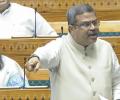
The DMK protested in the Lok Sabha after Union Education Minister Dharmendra Pradhan criticized the Tamil Nadu government for refusing to implement the National Education Policy (NEP) and accused them of "politics." Pradhan alleged that the state had initially agreed to the PM SHRI scheme but later backed out. The DMK, however, asserted that they have issues with the NEP and the three-language formula, and cannot accept it in full. The protests disrupted House proceedings, leading to an adjournment. The DMK members were angered by Pradhan's accusations, demanding the release of funds allocated for education in the state.

One reason the fee can't be lower than 3 per cent is that it is difficult for an RIA to do a good job and remain viable even at 3 per cent.
Can this growth in GST collection be sustained in the coming years? asks A K Bhattacharya.

Here are handful of the number of amendments expected and predicted by analysts in the Union Budget for 2013-2014.

Finance Minister Nirmala Sitharaman in her fifth Union Budget made five major announcements for the income tax assesse. She announced no changes in the old tax regime and confined her relief measures to the new tax regime. There have been no changes under the old tax regime.

Ask rediffGURU and tax expert Mihir Tanna your income tax-related questions.

'We have essentially tried to set out an agenda for the next five years and it, in essence, represents the political commitment to that agenda.'

Finance Minister Nirmala Sitharaman also said that the government proposes to increase the benefit of carrying forward losses for startups to 10 years.

Govt may tighten presumptive taxation norms and also do away with some deductions.

'We will start reaching out to researchers, academics, and experts on AI from top universities and companies from across the world.'

Hindi film industry hopes to get some tax relief from the upcoming Budget 2015-16.
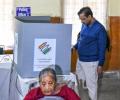
The BJP coined a new word for AAP, 'Aapda (crisis)', which Modi repeated constantly during the election campaign to show how Delhi residents's lives had become miserable under AAP's 11-year rule.

The government has approved the 'Terms of Reference' for the 16 Finance Commission, which makes recommendations on sharing of tax revenues between the Centre and states. The recommendations would cover a five-year period commencing April 1, 2026, Information and Broadcasting Minister Anurag Thakur said on Wednesday, giving details about the decisions taken at the Cabinet meeting last evening. The commission would submit its report by October 31, 2025, Thakur said.
 © 2026 Rediff.com - Advertise with us - Disclaimer - Privacy Policy - Sitemap - Feedback - About us - Terms of use - Grievances